Greece stands as a small yet mighty nation perched at the southernmost tip of Europe, serving as a historic bridge between eastern and western civilizations for over five thousand years. Throughout antiquity, it functioned as a crucial meeting point where commerce, philosophy, and culture fused into a civilization whose influence continues to shape our modern world. The enduring legacy of ancient Greece lies in how its foundational principles became the bedrock of Western civilization itself.
Quick Navigation
Landscape and Cultural Heritage
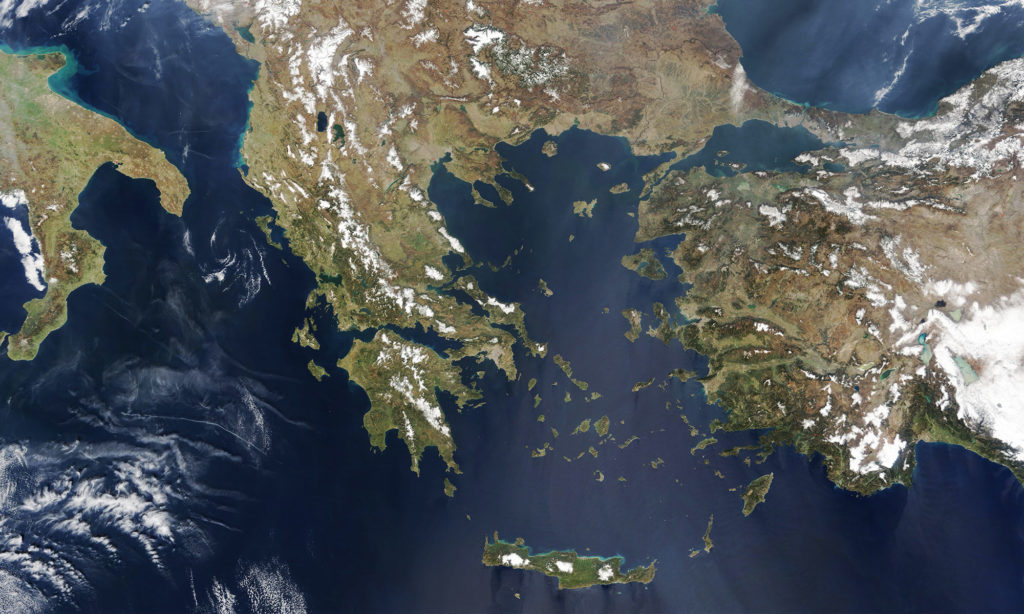
Greece's remarkable cultural and historical tapestry has left an indelible mark on its landscape, adorned with ruins and monuments spanning six millennia of human civilization.
Wave after wave of invaders, peaceful settlers, and the country's strategic position linking East and West have all contributed layers to the land's character, creating an open-air museum that beckons explorers from around the globe.
Archaeological treasures dating back to prehistoric times dot every corner of the country, while museums safeguard invaluable artifacts from the ancient world.
Nature has been equally generous to both mainland and islands, blessing them with a stunning array of geographic wonders and breathtaking vistas.
While the iconic blue and white palette dominates the most famous island landscapes, the mainland surprises visitors with its verdant mountains and golden hillsides bathed in Mediterranean sunshine.
The mainland's predominantly mountainous topography contrasts beautifully with the more than 2,000 islands scattered across its surrounding seas.
This varied terrain has historically fostered the relative isolation and independence of different population groups throughout Greece, each developing distinct cultural variations while maintaining a unified Greek identity rooted in ancient heritage and Orthodox Christian tradition.
Remarkably, despite the mountainous interior, you're never more than an hour's drive from the coastline anywhere in Greece—the sea is always within reach.
Geographic Boundaries
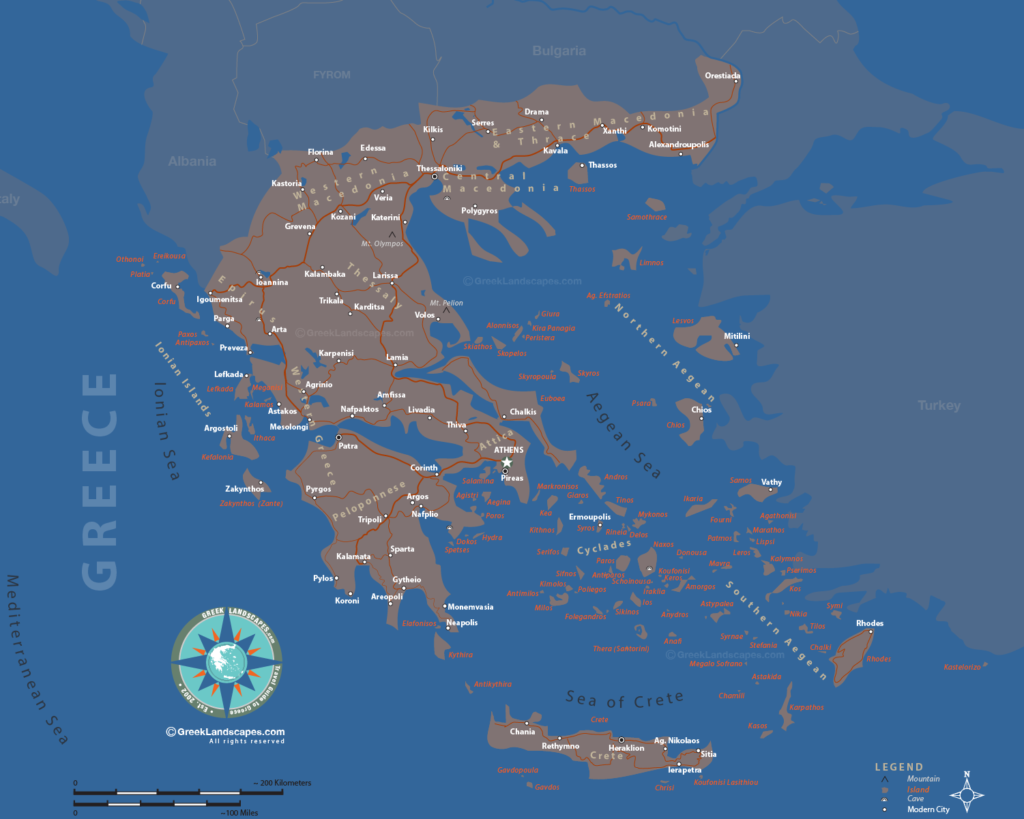
The Greek mainland extends across the Balkan Peninsula's southern reaches.
Greece shares its eastern border with Turkey, while to the north it borders Bulgaria, North Macedonia, and Albania.
The Libyan Sea laps at its southern shores, and the Ionian Sea washes its western coastline.
Climate and Weather Patterns
Average temperatures across Greece range between 14° and 20° Celsius, with the country divided into three distinct climatic zones based on weather patterns.
The Aegean islands, Attica region, and Crete enjoy abundant sunshine, minimal rainfall, and strong "meltemi" winds during summer months. Winter brings rainstorms and cooler temperatures, with snow accumulating temporarily in mountainous areas.
Across the Greek mainland—encompassing Peloponnese, Thessaly, Epirus, Macedonia, and Thrace—summers remain equally warm, though occasional rainstorms are more frequent. Winters turn harsh with regular thunderstorms and snow, while autumn and spring deliver substantial rainfall and occasional frost. The towering Pindos and Rhodope mountain ranges display snow-capped peaks throughout the winter season.
Currency Information

In 2000, Greece adopted the Euro as its official currency, replacing the historic drachma.
This change occurred alongside the majority of European Union member nations, which collectively embraced the Euro as Europe's common currency.
Learn more about handling money in Greece.
Popular Tourism Destination
Greece ranks among the world's most sought-after travel destinations, attracting millions of visitors each summer who nearly double the country's population as they come to experience its unique offerings.
Travelers choose Greece for various reasons: many seek relaxation in picturesque villages, on idyllic islands, or along pristine beaches; others come to immerse themselves in the vibrant Mediterranean lifestyle; and countless visitors arrive to explore the rich tapestry of history and culture.
The perpetual sunshine and the sea's mesmerizing shades of blue draw the majority of visitors, while the profound historical and cultural significance serves as another major attraction for curious travelers worldwide.
Quick Facts About Greece
Geographic Coordinates: 39°00' N, 22°00' E
Official Language: Greek
Predominant Religion: Orthodox Christianity
Urban Population: Approximately 60% of total population
Life and Health Statistics
- Life expectancy: 76 years (men), 81 years (women)
- Healthy life expectancy: 75.4 years (men), 69.0 years (women)
- Infant mortality rate: 6.1 per thousand live births
Social and Demographic Data
- Annual population growth rate (1995-2001): 0.27%
- Marriage rate: 4.3 per 1,000 people
- Divorce rate: 0.9 per 1,000 people
- Average household size: 3 persons
- Fertility rate (2000): 1.32
- Women in labor force: 40%
- Female students: 59%
- Literacy rate: 97.5% of population aged 15 and over
Population and Demographics
2010 Census Population: 10,787,690
- Male: 5,303,690 (49.2%)
- Female: 5,484,000 (50.8%)
Population by Geographic Region
| Region | Population |
|---|---|
| Attiki (Athens area) | 3,812,330 |
| Central Macedonia | 1,874,590 |
| Thessalia | 730,730 |
| Western Greece | 680,190 |
| Kriti (Crete) | 621,340 |
| Eastern Macedonia & Thraki | 606,170 |
| Peloponnese | 581,980 |
| Sterea Ellada | 546,870 |
| Ipiros | 336,650 |
| Southern Aegean Islands | 308,610 |
| Western Macedonia | 282,120 |
| Ionian Islands | 206,470 |
| Northern Aegean Islands | 197,810 |
| Agio Oros (Mount Athos) | 1,830 |
The National Flag

Greece's national flag features nine alternating blue and white horizontal stripes, with a blue square in the upper left corner containing a white cross.
According to popular interpretation, the blue and white colors represent the sea and waves that surround the country on all sides except the north.
The cross symbolizes the nation's deep-rooted Orthodox Christian tradition that has shaped Greek culture for centuries.
The nine stripes are said to correspond to the nine syllables in the Greek word for freedom (ελευθερία—elefthería).
An alternative interpretation suggests the stripes represent the syllables in the patriotic phrase "eleftheria i thanatos" (Freedom or Death), which became the rallying cry during the Greek War of Independence against Ottoman rule in 1821.
During this pivotal war, Andreas Londos first raised a Greek flag over the town of Vostitsa in the Northern Peloponnese around March 25, 1821. Vostitsa was among the first towns liberated, just days after Kalamata. This original flag displayed a black cross on a red background.

Shortly thereafter, this design evolved into a flag featuring a white cross extending edge to edge on a blue square background—no stripes included.
While you might occasionally spot this alternate flag in Greece today, the striped version has become the standard national flag.
Interestingly, the independence army in the 1820s used a flag with inverted colors: a blue cross on a white background.
Greek Language Heritage
The Greek language boasts continuous usage since prehistoric times, making it one of humanity's oldest living languages.

The earliest surviving written examples appear as Linear B tablets from the 15th century BCE.
Between 1000 BCE and 700 BCE, Greek inhabitants adapted the Phoenician alphabet to their needs. By the end of the 5th century BCE, they had transformed it into the 24-letter Greek alphabet still used today.
Throughout its 3,500-year journey through history, Greek has undergone numerous transformations, yet modern Greek remains easily traceable to its ancient roots through shared letters, word stems, and structural elements.
The historical continuity and persistent identity throughout Greek language evolution often receives special emphasis.
Despite morphological and phonological changes comparable to those in other languages, Greek has never experienced a cultural, literary, or orthographic break significant enough to suggest the emergence of an entirely new language since classical times.
Contemporary Greek speakers still regard ancient Greek literary works as their own heritage rather than foreign literature. Some linguists estimate that "Homeric Greek is probably closer to modern demotic Greek than 12th-century Middle English is to modern spoken English"—meaning Greek has changed less in 2,700 years than English has in 900.
Ancient Greek Dialects
In a dynamic nation like Greece where ideas have flowed freely and historical traditions define identities, the Greek language has never been uniform across the land. Instead, it has absorbed influences from other languages while developing several distinct dialects that diverge to varying degrees from official language standards.
Aeolic Dialect: Spoken in northwestern Asia Minor, northeastern Aegean islands, Arcadia in the central Peloponnese, parts of Boeotia around Thebes, and Cyprus.
Doric Dialect: Used throughout western Greece (Epirus, Aetolia, Acarnania), the southern and eastern Peloponnese, Crete, the Dodecanese islands, Corcyra (Corfu), Lefkada, Sicily, and Black Sea coastal settlements.
Ionic Dialect: Prevalent in Attica, Euboea, most of the Asia Minor coast, northern Greece (Macedonia, Thrace), and the majority of Aegean islands.
Over ancient Greece's thousand-year span, several other language variations emerged. Most influential among these was Attic Greek, which incorporated both Ionic and Doric elements.
Attic Greek became the common tongue throughout the civilized ancient world because Athens wielded such powerful cultural influence across the Mediterranean, and later because Alexander the Great spread the language throughout his vast empire, from Greece to Egypt and as far east as India.
Modern Greek Variations
Today, Greek continues to display regional variations in spoken form. For example, the Cretan dialect stands out for its distinctive pronunciation patterns.
Each region employs different words for identical objects, yet a rigorous public education system has standardized written Greek across the nation, achieving a remarkable 97.5% literacy rate over the past thirty years.
These dialect variations don't prevent Greeks from different regions from communicating comfortably. In fact, Greeks often joke about how impossible it would be for foreigners to master Greek completely—referring to the multitude of terms for the same things and the diverse dialects.
Government Structure
According to the U.S. State Department, "Greece is a developed and stable democracy with a modern economy."
Birthplace of Democracy
The concept of "Democracy" originated in ancient Greece, specifically in ancient Athens where citizens first gained the power to elect public officials—a revolutionary development in human history.
Democracy in ancient Greece reached its zenith during the fifth century BCE in Athens under Pericles' leadership.
Modern Greece functions as a parliamentary republic guided by a democratic constitution.
The Presidential Office
Greece's president serves as head of state, while the prime minister leads the government.
Parliament elects the president every five years, with a two-term maximum. A two-thirds parliamentary majority is required for election, ensuring consensus among multiple political parties.
The Greek president holds limited powers and primarily oversees constitutional governance.
The Prime Minister's Role
Parliament elects the prime minister following national elections that determine parliamentary composition. No term limits exist for this position.
Greece's parliament comprises 300 members elected through direct popular vote to four-year terms.
The political party holding the parliamentary majority elects the prime minister, typically their party leader.
Constitutional Foundation
The Greek Constitution establishes fundamental governance principles. Article 51 specifies parliamentary structure:
Parliament membership shall be established by law but cannot fall below 200 or exceed 300 members.
Members of Parliament represent the entire nation, not just their constituencies.
Citizens elect members through direct, universal, and secret ballot. Voting rights may only be restricted due to minimum age requirements, legal incapacity, or irrevocable criminal conviction for certain serious offenses.
Greece divides administratively into 13 regions, further subdivided into 51 prefectures.
International Partnerships
Greece maintains membership in the United Nations (joined October 25, 1945), the European Union (member since 1981), and NATO (allied since 1952).
Greece served as a non-permanent member of the UN Security Council during 2005-2006.
Economic Overview
Greece operates a mixed capitalist economy where the service sector accounts for approximately 71% of total GDP, with industry and agriculture comprising the remaining 29%.
Since 2008, Greece has faced significant economic challenges, particularly regarding debt repayment, requiring assistance from the European Union and IMF.
European Union Integration
Greece has gained substantial benefits from European Union membership. Until 2009, the Greek economy grew at 3-4% annually, while inflation dropped from roughly 13% in the early 1990s to about 3.5% by 2004.
Though per capita income appears modest compared to other Eurozone nations, the fact that approximately 80% of Greeks own their homes contributes to a comfortable lifestyle for most citizens.
Notably, until 2011, homeowners paid no annual property taxes on their residences.
Maritime Tradition
Greece has maintained its status as a seafaring nation since the Bronze Age (3000-1000 BCE), when Minoans dominated the Aegean Sea.
Between the 8th and 5th centuries BCE, Greeks colonized the northern Mediterranean and Black Sea regions.
Athenian naval supremacy in the 5th century BCE enabled the extraordinary cultural flourishing we admire today.
This maritime tradition has endured throughout history, with Greek merchant fleets consistently ranking among the world's largest.
As of 2010, Greece "owns one-seventh of the world's fleet measured by deadweight tonnage. Its merchant fleet ranks as the world's second largest after Japan, ahead of China and Germany, at 140.7 million deadweight tonnes."